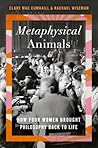
 Metaphysical Animals: How Four Women Brought Philosophy Back to Life by Clare Mac Cumhaill and Rachael Wiseman
A group biography of four women who were all Oxford undergraduates and emerged as professional philosophers after the Second World War, Metaphysical Animals is an ambitious project, interweaving four disjointed lives with social and political trends, as well as telling the story of how its protagonists set themselves against the current male-dominated philosophical orthodoxy.
The logical positivist A.J.Ayer provided a clear target. His influential Language, Truth and Logic (1936) cut through what he saw as metaphysical mumbo-jumbo with the demand that philosophy should confine itself to linguistic propositions that could be proved or disproved. Logical formulae began to make philosophy papers look more like maths.
But where did that leave morality and ethics? Out in the cold and, as Cumbhaill and Wiseman repeatedly tell us, subject to the withering put-down by smart, young and almost always male philosophers, “I don’t understand that”, which, they comment, was “no longer the beginning of a philosophical conversation, but the end of one”.
The resistance was led by Elizabeth Anscombe, Phillipa Foot, Mary Midgley and Iris Murdoch, the subjects of this book. Their work began, as the book’s clever double-meaning subtitle puts it, to “bring philosophy back to life” in response to what Midgley described as the “pure weedkiller” of the logical positivists’ approach.
Whilst “good” and “bad” might, as Ayer insisted, mean no more than “hooray” or “boo”, they argued that more specific words with moral overtones, like “shame”, “pride”, “brave” or “respect”, are complicated ideas created as “symbolic objects” in our culture. A child, as it learns, “must ‘catch on’ to the meaning of these descriptions and come to see his own actions and the actions of those around him under them”.
Through varied representations of culture, including poems, stories, maps and words, the agreed meaning of such words is shared. It depends on context, which in turn is part of the whole canvas of society and history. As “metaphysical animals”, we “dwell in the past as well as the present” and a philosophy which properly reflects life as experienced cannot be isolated from those unquantifiable complexities – however unsatisfactory that might seem to the logical positivists.
The book links the social history of the women philosophers’ influence to the changing population of Oxford during the war. Men disappeared as they were called up, Jewish academic refugees appeared as they managed to escape the Nazis and at the end of the war, the university population swelled again with those who had missed out during the war years.
The authors struggle to knit the turbulent lives of the four women with their many partners, spouses, dependents and changing professional lives into a coherent narrative and the reader needs to keep on top of a large and changing cast of peripheral characters (but there is always the index to help).
Cumbhaill and Wiseman do a skilful job in connecting the evolving thinking of each of the four philosophers with that of the other three, highlighting meetings, conversations and shared crises as points when the philosophical ideas can be explained, in just enough detail to provide a sense what was at stake.
The women seem to have had a wider influence than today’s philosophers, often being invited to give BBC radio talks with titles like “The Natural History of Contradictions” and “The Novelist as Metaphysician” and churning out articles and reviews for general publications. Their message and tone, after all, was far more digestible than that of the logical positivists.
I’m left wondering is what impact on Oxford philosophy. or philosophy in general, the women had. In their battle to bring “philosophy back to life”, were they successful? I suspect not, because if they had been, the authors would surely have ended on that note of triumph. Did they have a partial success or create a side-stream that is still flowing today? The reader of Metaphysical Animals will be rooting for them, so I hope there is still something to cheer about.
View all my reviews

No comments:
Post a Comment