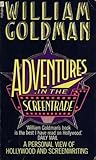
 Adventures in the Screen Trade: A Personal View of Hollywood and Screenwriting by William Goldman
Do they teach this book in film school? It's so readable, so gossipy and interesting you might think not because it's too much fun.
But it's also so practical, so illuminating about the craft and, especially, about the complex web of human relationships involved in film-making, you might think film schools would be crazy not to insist that every student read, learn and inwardly digest it.
William Goldman's account of his working life can't help but include stories about colleagues like Robert Redford, Dustin Hoffman, Clint Eastwood and others. He talks about disastrous films. And great films that were counted as disasters. And about the many kinds of hell he was put through as a writer on projects that lasted months or years and then never happened.
So the book is part tutorial - what a scriptwriter actually does - and part autobiography. And the joy of the latter is that he gives himself no airs, despite having written, Butch Cassidy and the Sundance Kid (1969) and All the President's Men (1976), A Bridge too Far (1977), Marathon Man (1976), Misery (1990) and many others.
At the end of the book, there's a very specific treat: the chance to see how he adapts a short short (his own) into a script, and then has other professionals (a designer, cinematographer, editor and composer) critique it, as if they were preparing to be part of its production. The reader gets a chance to see exactly what kind of detailed issues would arise.
The highlight of that section is the comments of the director George Roy Hill (he of Butch Cassidy, Slaugherhouse Five, The Sting and The World According to Garp), who is unrestrained in his rudeness about Goldman's script:
“What you've done here is take a story that works pretty well on paper, but you really make some fundamental errors in your screenplay -and since you are very glib and very clever and very able, you have covered up those errors and masked them so that most people would not see them. But I would I think be inclined to unmask you.”
What follows is a scathing analysis, which you'd think would make any writer either give up on the whole idea of the film, or abandon the idea of working with Hill. But Goldman takes it on the chin, and lets us witness his humiliation - in his own book.
"Pretty withering," Goldman comments when Hill has finished, "but pretty helpful too". He's a brave man. He says he disagrees with what Hill says but adds - three times - "he may be right".
What comes out of the book is that screenwriting may be lonely work - just you and pages to fill. But it is equally a role that required deft handling of people. And not just ordinarily awkward people, but Hollywood people, people with huge egos, huge wealth and ambition who didn't get where they are by trying to make everyone happy. And they are people under pressure: to get decisions, to avoid wasting millions or blowing their own professional reputations, and all that against deadlines.
In the end, Goldman's message is that for all his experience and professionalism, in Hollywood "nobody knows anything". The public can just as easily ignore a film that Hollywood insiders think is brilliant and love one that Hollywood has written off as a dud. If it was easy, I suppose they wouldn't get paid what they do.
View all my reviews

No comments:
Post a Comment