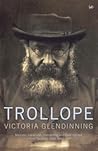
 Trollope by Victoria Glendinning
My rating: 5 of 5 stars
Trollope: a genius, and much more
Victoria Glendinning’s comprehensive account of the life of Anthony Trollope manages to be both humane and scholarly. His was a life of such stress, such achievement, such tragedy and strain, physically, mentally and emotionally, that it is hard to believe he even survived to the 67 years he managed.
His energy and prolific output in the face of impossible odds mirrored that of his mother, Fanny Trollope, who raised herself up the social ladder through sheer determination; and his insecurities and suffering – including rejections in both his official Post Office work and often in his writing – was the story of his hopeless, unpopular barrister father.
Glendinning illustrates Trollope’s emotional life and illuminates many interesting aspects not covered by his letters or other archives by finding relevant passages in his fiction, always so fitting that her reader cannot question their contribution to our understanding of the man.
Trollope lived in at least four worlds: his family, his career at the Post Office, his imagination, always churning away with more output, his social life, with his love of hunting and hearty sociability at London clubs, and his business world, in which he juggled contracts, commissions, property moves and constant handouts to needy family members or distant relatives.
It is an exhausting story but Glendinning keeps it fresh and interesting at every turn – through the constant travelling, around Ireland, Britain, Europe, the West Indies, America (twice), South Africa and Australia (twice). Even with today’s streamlined transportation it would be a lot but how he did it in Victorian conditions and churning out his daily quota of words too is hard to fathom.

In his late fifties, to carry out his commission for a travel book on Australia, for instance, he “rode up to sixty miles a day through endless forests of gum trees, with the necessities strapped to his saddle”. This large, famous, bearded figure caused offence at dinners given in his honour on such trips because he could only appear in his travelling clothes. And apart from that he was always a loud, boisterous character, not at all what his readers had imagined.
Trollope had a long and apparently successful marriage, to Rose Heseltine – a woman who seems to have been notable more by the absence of defining characteristics than by anything that allows us to bring her into focus. It is an acknowledged area of mystery in the portrait, mainly illuminated by a persuasive selection of marital situations from the novels which one cannot help thinking had their inspiration in the writer’s own private life.
My only wish for more would be about how Trollope actually wrote his novels and managed to be so extraordinarily prolific - 47 novels (compared to Dickens’ 15, for instance). We learn that he was not much of a planner, often deciding key plot points on a whim and not knowing how the story would end. And that his lonely childhood gave him a facility for day-dreaming, which, on long journeys for the Post Office turned to imagining stories.
But still, how did he keep so many richly imagined worlds in play in his brain and how was he always able to continue writing, limited only by time and never by his ideas or difficulties with what he had started?
I suppose the answer is simply that the man was a genius – and as Glendinning shows us – an unlikely one, whose gift was easy to miss among the other many extraordinary circumstances of his life.
View all my reviews